Industrial humidity control keeps relative humidity within a set band using sensors, controllers and humidifiers or dehumidifiers. In the UAE's hot, coastal climate it protects food, pharma, electronics, warehoused goods and print quality from moisture damage.
Why is industrial humidity control critical in the UAE climate?
Industrial humidity control is critical in the UAE because the local climate swings between extreme outdoor moisture and very dry conditioned air, and both damage stored goods and processes. Coastal cities such as Dubai, Abu Dhabi and Sharjah routinely see 60–90% outdoor relative humidity (RH) in summer, with dew-point temperatures above 25°C. When humid air enters a chilled store or cleanroom it causes condensation, corrosion, mould and caking; conversely, aggressive air-conditioning can drop RH below 30%, creating static discharge and product shrinkage. A dedicated humidity controller holds RH inside a defined band regardless of the weather outside, protecting product quality, reducing spoilage and meeting the documented conditions that DEWA-connected facilities, HACCP food plants and GMP pharma sites are audited against.
Which UAE industries need humidity control the most?
The UAE industries that most need humidity control are food processing and cold storage, pharmaceuticals, warehousing and logistics, electronics manufacturing, and printing. Food and cold-chain facilities in Dubai Industrial City and Al Quoz hold chilled stores at high RH (85–95%) to stop produce dehydrating, while dry-goods warehouses keep RH below 60% to prevent caking and mould. Pharmaceutical and nutraceutical plants run GMP cleanrooms at 45–60% RH. Electronics and PCB assembly lines control RH to 40–60% to avoid electrostatic discharge (ESD) and moisture-sensitive component damage. Commercial print houses hold paper stores at 45–55% RH for dimensional stability and registration. Textile mills, mushroom farms, incubators/hatcheries and museum/archive stores round out the demand across the Emirates.
What relative humidity levels do different applications require?
Each application has a target relative humidity (RH) band, and the controller's job is to hold RH inside it. Typical UAE set-points are: pharmaceutical GMP cleanrooms 45–60% RH; ESD-safe electronics assembly 40–60% RH; commercial printing and paper storage 45–55% RH; dry-goods and pharma warehousing below 55–60% RH; chilled fruit and vegetable stores 85–95% RH; mushroom growing rooms 80–90% RH; poultry incubators and hatcheries 50–60% (setter) rising to 65–75% (hatcher). A controller such as the Multispan MHC 512 lets you enter the set-point plus a hysteresis (deadband) of 0.1 to 20 units, so the humidifier or dehumidifier switches only when RH drifts outside the band — preventing rapid relay chatter and energy waste.
What equipment is used for industrial humidity control?
A complete industrial humidity control system uses four building blocks: a humidity sensor, a controller, an actuator, and the air-handling that moves conditioned air. The sensor (a capacitive RH probe such as the Multispan RH-85 or RH-100) measures moisture; the controller compares it to the set-point and switches outputs. To raise RH the controller drives a humidifier — steam, ultrasonic or evaporative. To lower RH it drives a dehumidifier or signals the air-handling unit (AHU) / chilled-water coil to condense moisture out; desiccant dehumidifiers are used where very low RH is required. Combined humidity-and-temperature controllers (Multispan MHT-1202/MHT-9044) manage both variables together, and RS-485 Modbus models feed readings to a building management system (BMS) for logging and DEWA energy reporting.
Which Multispan humidity controllers are available in the UAE?
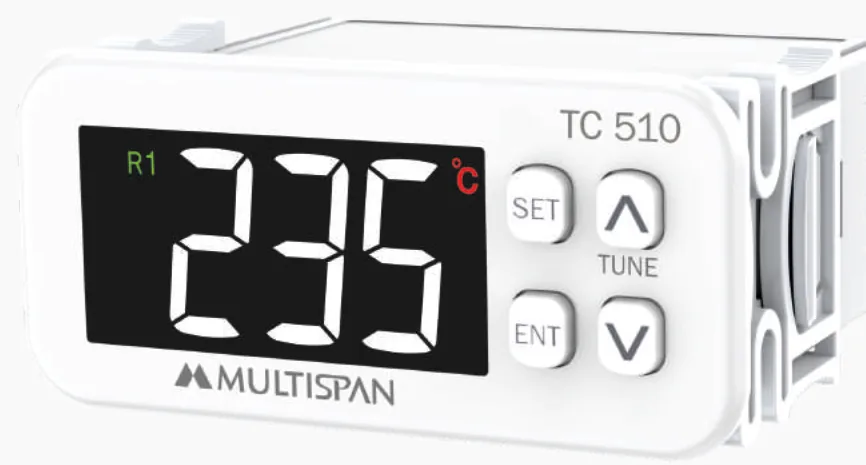
Al Misbah Al Sehri, the authorized Multispan distributor for the UAE and GCC, stocks three core humidity-related controllers in Dubai. The MHC 512 is a digital ON-OFF humidity controller with dual 10 A relays — first relay for humidification or dehumidification, second for a high/low alarm — a 0–100% RH range, ±1% FSD accuracy and 0.1% RH resolution, using RH-85 or RH-100 sensors, powered from 230V AC or 24V/12V DC in a 37×78×70 mm panel case. The MHT-1202/MHT-9044 combines humidity and temperature control in one unit with RS-485 Modbus for BMS integration. The TC 510 handles the temperature loop where humidity and temperature are controlled separately. All are genuine, CE-marked and delivered across the seven emirates.
How do humidity sensors and controllers work together?
A humidity sensor and controller work together as a closed control loop: the sensor continuously measures relative humidity, the controller compares that reading to your set-point, and it energises a relay when RH crosses the deadband. In a Multispan MHC 512, the RH-85 or RH-100 capacitive probe feeds a 0–100% RH signal to the controller, which displays it on a 3-digit 7-segment display and switches its 10 A relay to a humidifier or dehumidifier. Hysteresis (adjustable 0.1 to 20) sets how far RH must drift before the relay changes state, and an offset adjustment (−9.0 to +9.0) trims the reading to a calibrated reference. The second relay drives a high/low alarm, and Modbus models log values so out-of-band excursions are recorded for audit.
What standards and guidelines govern humidity control in the UAE?
UAE humidity control is governed by a mix of international standards and sector regulations rather than a single humidity code. GMP pharmaceutical facilities follow WHO and EU GMP guidance and are inspected by the Ministry of Health and Prevention (MOHAP); food sites follow HACCP and Dubai Municipality food-safety rules; cleanroom classification uses ISO 14644. Electrical enclosures for controllers are rated to IEC 60529 (IP protection) against Gulf dust and moisture, and instrument climatic robustness references IEC 60068. Panels connected to the grid must meet DEWA and IEC 61439 switchgear requirements. For occupant comfort in offices and malls, ASHRAE 55 recommends roughly 30–60% RH. In practice, auditors expect documented set-points, calibrated sensors and logged RH data — which is why Modbus-capable controllers are specified.
How do you specify and size an industrial humidity control system?
Specify a humidity control system by defining the target RH band, the room's moisture load, and how the reading will be logged. Start with the application set-point (for example 50% RH ±5% for a print room), then calculate the moisture load — occupancy, fresh-air infiltration in the humid UAE climate, and process sources — to size the humidifier or dehumidifier capacity in kg/h of water. Choose sensor placement in the representative air path, not near doors or diffusers. Select a controller matched to the actuator: an ON-OFF unit like the Multispan MHC 512 for single-stage humidify/dehumidify, or an MHT-1202 with RS-485 Modbus where temperature is coupled and BMS logging is required. Confirm supply voltage (230V AC or 24V DC), relay rating (10 A) and IP-rated enclosure. Send your requirement to Al Misbah Al Sehri for model selection and stock.