A practical guide to specifying a DIN-rail switch-mode power supply for control panels — how to size the 24V DC load, plan redundancy, and derate correctly for Dubai's ambient temperatures.
Why the SMPS is the quiet heart of the panel
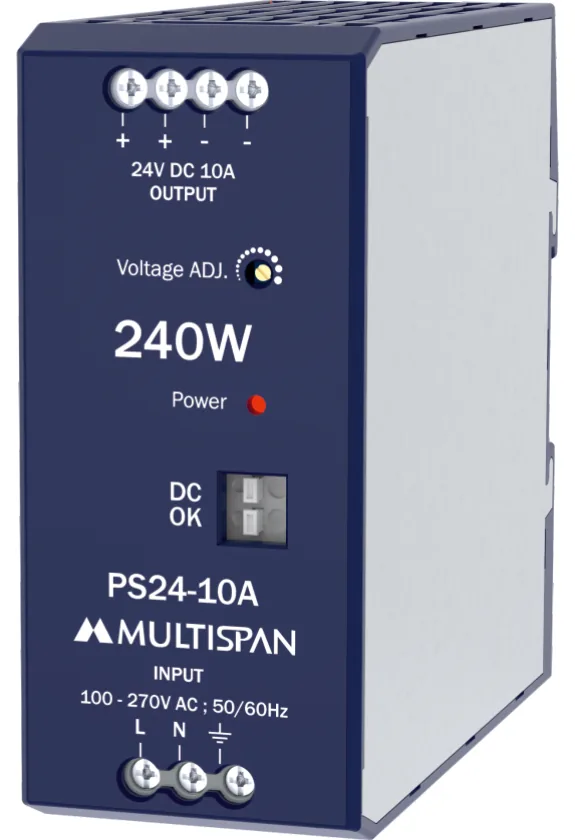
Almost every modern LV control panel runs its logic on a single low-voltage DC rail — typically 24V DC. The PLC, relays, HMI, proximity sensors, solenoid valves and communication devices all draw from it, which means the switch-mode power supply (SMPS) is a single point of failure. If it browns out or shuts down on over-temperature, the whole control system stops even though the incoming three-phase supply is healthy. A DIN-rail SMPS is compact and efficient, but that same compactness concentrates heat inside the enclosure. Getting the selection right — voltage, current, redundancy and derating — is therefore one of the higher-value decisions a panel builder makes, especially in the UAE where ambient conditions are unforgiving. Multispan DIN-rail SMPS units, which Al Misbah Al Sehri stocks and fits, are a common choice for this rail.
Fixing the output voltage: why 24V DC dominates
24V DC is the de facto standard for industrial control because it balances safe touch voltage, low cable losses and wide device support. PLC I/O cards, most sensors and solenoids, and many contactor coils are all specified for 24V DC. Some installations still need 12V DC for specific electronics or 48V DC for telecom-style loads, and a few instruments want a tightly regulated rail. Before choosing, list every device the SMPS will feed and confirm they share the same nominal voltage; mixing voltages usually means separate supplies rather than one large unit. Check the tolerance too — sensitive analogue instruments may want the trimmable output (often adjustable roughly 24 to 28V DC) so you can compensate for volt-drop on long DC runs inside a large distribution board.
Sizing the current: add the loads, then leave headroom
Start by tabulating the steady-state current of every 24V device at full duty, then add the inrush and simultaneous-switching peaks — banks of relays, solenoids and contactor coils can momentarily pull several times their holding current. Sum the continuous load and size the SMPS so this figure sits at roughly 50 to 70 percent of its rated output. That headroom covers inrush without nuisance shutdown, keeps the unit cooler, and leaves room for future additions. As a worked example, a panel drawing 6A continuous points toward a 10A (240W) supply rather than a 6.3A unit run flat out. Also confirm the SMPS can deliver enough peak or start-up current for capacitive loads and HMIs; many quality units provide a short-term boost above their continuous rating for exactly this reason.
Derating for UAE heat: the number that catches people out
Every SMPS carries a full rating only up to a reference ambient — commonly 40 to 45C — and must be derated above it, typically losing 2.5 to 3 percent of output per degree C. The trap is that the relevant temperature is inside the enclosure, not the air-conditioned room. In a sealed Dubai panel the internal air can sit 10 to 20C above outside ambient, so a cabinet in a 45C plant room can easily reach 60C internally. A 10A supply derated at 3 percent per degree above 45C loses about 45 percent at 60C — leaving roughly 5.5A usable. This is exactly why the 50 to 70 percent loading rule matters: it builds the derating margin in from the start. Where possible, add ventilation, a filtered fan, or a panel cooler, and mount the SMPS with clearance above and below so convection can work.
Redundancy: when one supply is not enough
For critical processes, a single SMPS is a liability. The common architecture uses two supplies of equal rating feeding a redundancy (diode/ORing) module, which decouples the outputs so that either unit can carry the full load and a failed unit is isolated without dragging the rail down. Each supply should be sized to carry 100 percent of the load on its own, not 50 percent, so the survivor holds up the panel after a failure. Some designs instead use N+1 sizing across several units. Redundancy also buys maintenance flexibility — you can replace a failed unit live. It is not free: it costs board space, a redundancy module and roughly double the supply cost, so reserve it for loads where an unplanned stop is genuinely expensive or unsafe.
Practical wiring, protection and mounting notes
Protect the AC input with a correctly rated MCB or fuse per the manufacturer's data, and fuse or use protected distribution on the DC side so a single shorted branch cannot collapse the whole rail — a distributed 24V system benefits from electronic load-protection modules that trip individual channels. Use adequate DC conductor sizing to limit volt-drop, and keep the SMPS away from heat-producing neighbours such as VFDs and braking resistors. Leave the vented sides unobstructed, keep it off the hottest top zone of a tall cabinet if convection allows, and route control cabling clear of the ventilation path. Finally, confirm the certifications you need — CE and the relevant safety and EMC marks — and that the unit's input range suits the local supply, since UAE mains can dip and swing during peak summer demand.
A short specification checklist
Before you order, confirm: the output voltage matches every load (usually 24V DC); the continuous load sits at 50 to 70 percent of rated current with peak/inrush covered; the rating still holds after derating for the real internal enclosure temperature, not room ambient; redundancy is specified where an unplanned stop is costly, with each unit sized for the full load; input voltage range and protection suit UAE mains; and mounting allows convection and, where needed, forced cooling. Al Misbah Al Sehri sizes and fits Multispan DIN-rail SMPS units into MDB, MCC and custom control panels built to IEC and DEWA requirements, and can advise on the right rating for your load and enclosure conditions. Ring +971 4 320 3957 or email sales@misbahswitchgear.com to discuss a specific panel.