A balanced look at PID versus ON-OFF temperature control — accuracy, overshoot, cost and where each fits — with a clear recommendation. Multispan controllers support both modes.
The short answer
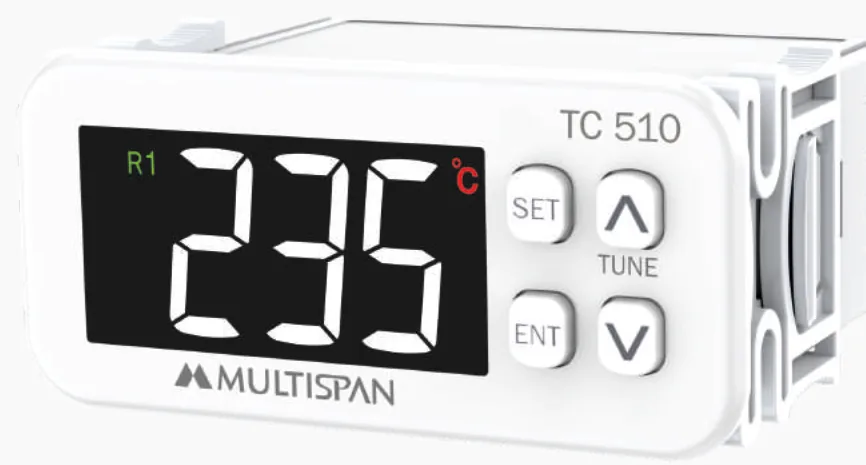
Both ON-OFF and PID keep a process near a target temperature, but they get there differently. ON-OFF switches the heater or cooler fully on below the setpoint and fully off above it — simple, robust and inexpensive. PID (Proportional-Integral-Derivative) continuously modulates the output, easing off as the temperature approaches the setpoint to hold it tightly with little overshoot. As a rule, choose ON-OFF where a few degrees of swing is acceptable and PID where precision and stability matter. Many modern digital controllers, including the Multispan TC series, support both modes in a single unit, so the decision is about configuration rather than buying different hardware.
How ON-OFF control works
ON-OFF control (also called bang-bang or hysteresis control) compares the measured temperature to the setpoint and drives the output to one of two states. To stop the relay chattering around the setpoint, a hysteresis or dead-band is applied — the output turns on a little below the target and off a little above it. This produces a characteristic saw-tooth temperature cycle. The width of the swing depends on the dead-band setting and the thermal mass of the process. ON-OFF is easy to set up, tolerant of imperfect tuning, and well suited to relay or contactor outputs. Its trade-off is continuous cycling and temperature oscillation around the setpoint.
How PID control works
PID control calculates the output from three terms. The proportional term responds to how far the temperature is from the setpoint; the integral term removes the steady-state offset that proportional-only control leaves behind; and the derivative term reacts to the rate of change, damping overshoot. Together they let the controller taper the power as the process nears the target, holding it steady with minimal oscillation. PID usually drives a time-proportioned relay or, better, an SSR output for fast, high-cycle switching. It needs tuning — often via an auto-tune routine that learns the process — but once set it delivers far tighter control than ON-OFF.
Side-by-side: accuracy, overshoot and cost
Accuracy: ON-OFF holds within the dead-band, typically a few degrees; PID can hold to a fraction of a degree on a stable process. Overshoot: ON-OFF overshoots and undershoots continuously as it cycles; PID minimises overshoot after the initial approach. Output wear: ON-OFF cycles a relay or contactor frequently, adding mechanical wear; PID with an SSR switches rapidly with no moving contacts. Setup: ON-OFF needs only a setpoint and dead-band; PID needs tuning, though auto-tune simplifies this. Cost: the control mode itself adds little cost on a dual-mode controller — the real cost difference is usually the SSR and heater sizing PID benefits from. Stability: PID is the clear winner where the process must sit precisely on target.
When ON-OFF is the right choice
ON-OFF suits processes with large thermal mass and slow response, where the temperature naturally moves slowly and a modest swing does no harm. Typical examples include room and enclosure heating, water heaters and tanks, many HVAC and refrigeration duties, defrost cycles, and simple oven or incubator applications. It is also the pragmatic choice where a contactor already switches the load, where operators want a control that is easy to understand and adjust, or where the budget and cycling requirements do not justify an SSR. If a couple of degrees of variation around the setpoint is acceptable, ON-OFF is reliable and cost-effective.
When PID is worth it
PID earns its keep on fast, low-mass processes and anywhere product quality depends on a stable temperature. Plastic extrusion and injection moulding, heat sealing, soldering and reflow, laboratory and pharmaceutical equipment, kilns, and precision drying or curing all benefit from tight control and low overshoot. PID is also preferable where overshoot could damage product or equipment, or where frequent relay cycling would shorten contactor life — pairing PID with an SSR removes that wear entirely. If you need the temperature to sit on target rather than swing around it, PID is the correct approach.
Our recommendation, and both options genuine
Match the control mode to the process, not to a preference. Choose ON-OFF for high-mass, tolerant applications where simplicity and low cost win; choose PID with an SSR for fast or precision processes where stability and minimal overshoot matter. Because dual-mode digital controllers cost little more, a sensible default is a controller that does both, configured to suit the job and re-tuned if the process changes. As the authorized Multispan distributor for the UAE and GCC, we supply Multispan controllers that support both ON-OFF and PID, and we stock genuine temperature controllers, sensors and SSRs from the brands we carry. Tell us your sensor type, load and accuracy target and we will recommend the right model and settings.