MCBs and MCCBs both protect circuits, but differ in current rating, breaking capacity and adjustability. Here is how they compare and when to use each in a UAE panel.
MCB vs MCCB at a glance
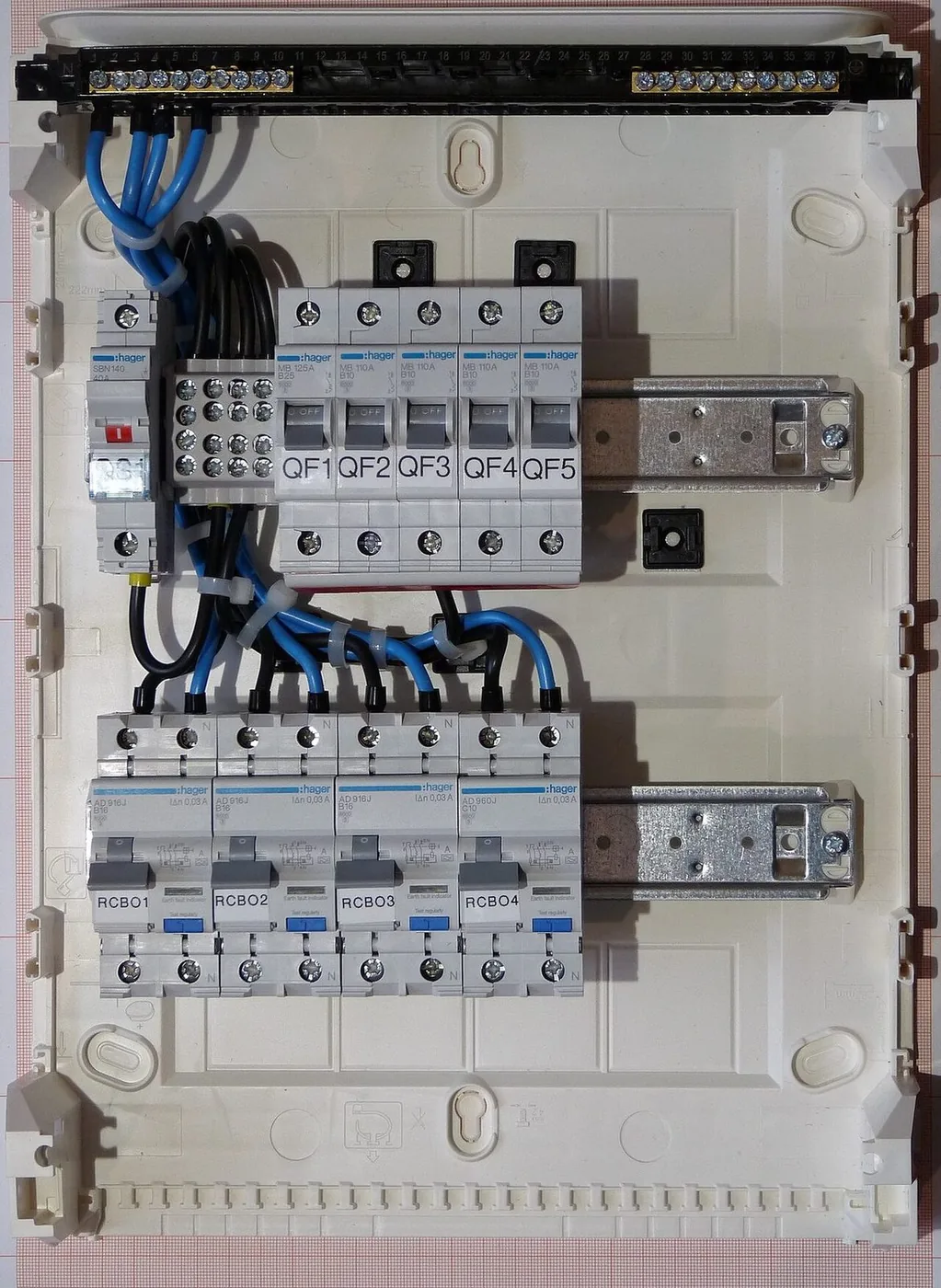
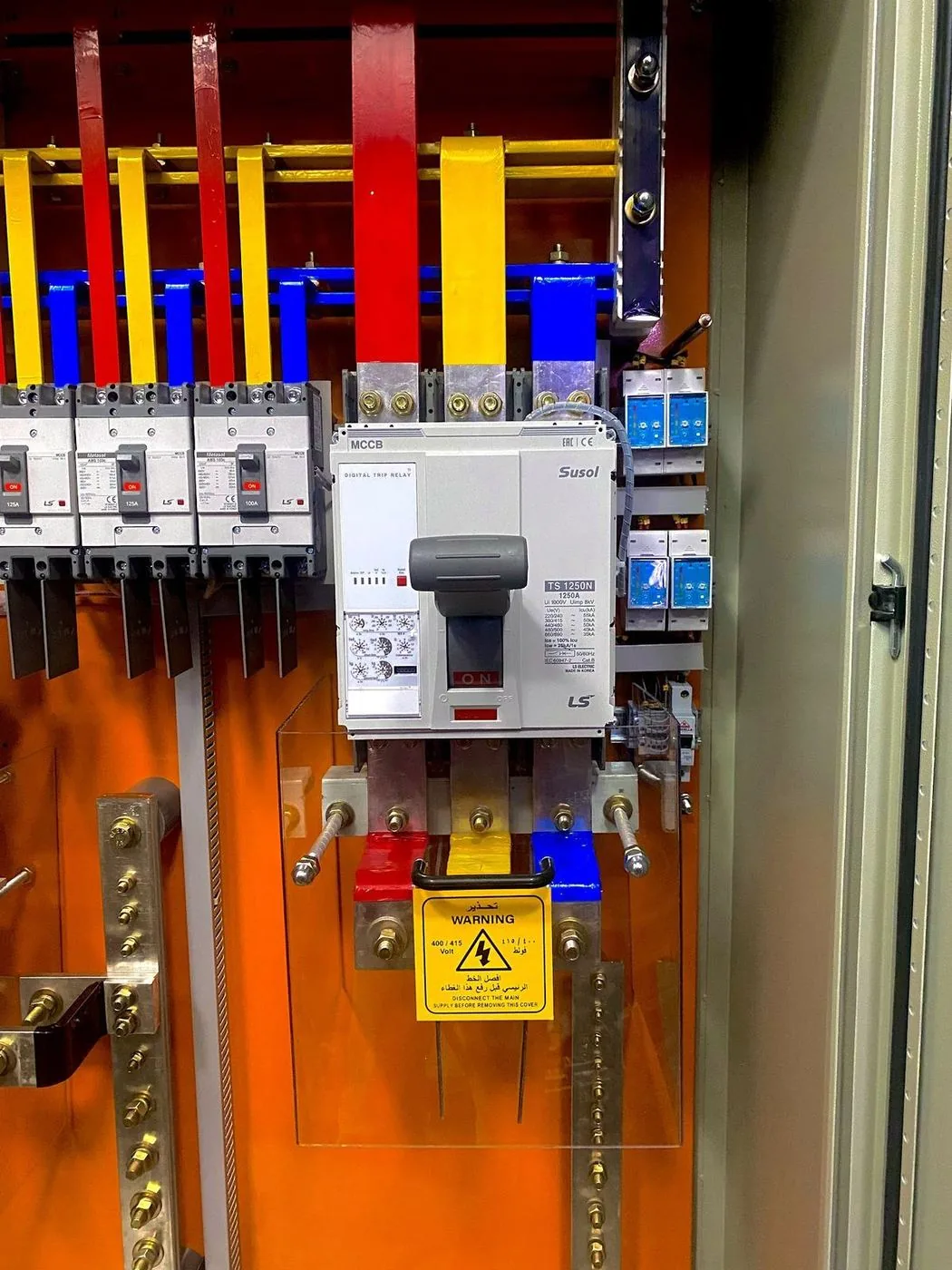
Both an MCB (Miniature Circuit Breaker) and an MCCB (Moulded Case Circuit Breaker) protect a circuit by tripping on overload and short-circuit. The practical difference is scale and control. An MCB is a compact, DIN-rail device with a fixed trip, used for final circuits and light distribution. An MCCB is a larger, moulded-case device with a higher current rating, a much higher fault-withstand and — on most models — an adjustable trip. In a typical UAE panel you will find MCCBs upstream as incomers and feeders, and MCBs downstream feeding lighting and small-power circuits.
Current ratings and frame size
Current rating is the first dividing line. MCBs cover roughly 0.5 A to 125 A, though most final circuits sit at 6–63 A, and the body is a slim single module per pole. MCCBs span a far wider band — commonly 16 A up to 800 A, with larger frames reaching 1250–1600 A and beyond — organised into standardised frame sizes. Because an MCCB carries more current, it is physically bigger, heavier and needs more panel space and busbar. As a rule, once a circuit exceeds about 100–125 A you move from an MCB to an MCCB (or an ACB at the very top end).
Breaking capacity: the critical UAE factor
Breaking capacity (Icu/Ics, in kA) is how much fault current a breaker can safely interrupt, and it is often the deciding factor in UAE installations. MCBs to IEC 60898-1 are typically rated 6 kA or 10 kA, with industrial MCBs to IEC 60947-2 reaching higher. MCCBs are built for severe faults, commonly 25–100 kA depending on frame and model. Near a large DEWA transformer the prospective short-circuit current at the main board is high, so incomers and main feeders need an MCCB (or ACB) with adequate kA. The breaker's rating must always exceed the fault level at its point in the system.
Adjustability, trip curves and protection
An MCB has a fixed thermal-magnetic trip selected by its curve — B, C or D for increasingly higher inrush loads such as motors. You choose the rating and curve; you cannot fine-tune them. Most MCCBs offer adjustable protection: at minimum an adjustable thermal (overload) setting, and on electronic-trip models full LSI or LSIG functions (long-time, short-time, instantaneous, and earth-fault). That adjustability lets an MCCB be tuned to the exact load and coordinated with breakers upstream and downstream — important for discrimination in a multi-tier MDB/SMDB/FDB system, and for protecting motors and transformers precisely.
Side-by-side comparison
In short: current rating — MCB up to about 125 A, MCCB from 16 A to 1600 A and above. Breaking capacity — MCB typically 6–10 kA, MCCB 25–100 kA. Trip — MCB fixed with B/C/D curves, MCCB adjustable or electronic. Poles — both offered in 1–4 poles. Size and cost — MCB compact and low-cost, MCCB larger and dearer. Typical use — MCB for final and sub-circuits, MCCB for incomers, feeders and motor protection. Standard — MCB to IEC 60898-1 or 60947-2, MCCB to IEC 60947-2.
When to use which in a UAE panel
The verdict is not one over the other — they work together. Use an MCCB where current is high, the fault level is significant, or you need adjustable, coordinated protection: main incomers, SMDB and MDB feeders, motor and transformer circuits. Use an MCB where current is modest and the fault level is lower: final distribution boards, lighting and small-power ways, control supplies. A well-designed UAE panel cascades from an ACB or MCCB incomer, through MCCB feeders, down to MCB final circuits — each device rated for the current and fault level at its point in the single-line diagram.
Genuine breakers and panels from Al Misbah Al Sehri
We supply genuine MCBs and MCCBs from established brands — ABB, Schneider Electric, Legrand, Hager, Siemens, Himel, LS and others — as loose components or built into panels. As a Dubai switchgear manufacturer, we build MDB, SMDB and FDB boards to your load schedule and single-line diagram, selecting the correct rating, breaking capacity and trip type for the fault level at each point, to IEC and DEWA-standard practice. Send us your requirement and our team will advise on the right breaker mix and quote genuine stock across the UAE and GCC.