Air circuit breakers and moulded-case circuit breakers protect low-voltage systems in different ways. Here is how they compare on current, withdrawability, maintenance and cost — and how to pick your MDB incomer.
ACB and MCCB at a glance
Both an Air Circuit Breaker (ACB) and a Moulded-Case Circuit Breaker (MCCB) protect a low-voltage circuit against overload and short-circuit, but they are built for different parts of the system. An ACB is a large, open-construction breaker with an air-break interrupting mechanism, an electronic trip unit and, usually, a draw-out chassis. An MCCB is a compact device housed in an insulated moulded case, using thermal-magnetic or electronic tripping. In an installation, the ACB tends to sit at the head of a large main board handling very high current, while MCCBs serve incomers and outgoing feeders across a much wider spread of ratings.
Current ratings and breaking capacity
This is the clearest dividing line. MCCBs typically cover roughly 16 A up to about 1600 A, with breaking capacities commonly in the 25–100 kA range depending on frame and class. ACBs start higher — usually from around 630 A and extend to 6300 A, with high breaking and short-time withstand ratings that suit heavy fault levels near a transformer or generator. Between roughly 630 A and 1600 A the two overlap, so both are technically valid and the decision shifts to cost, fault level and whether you need withdrawability. Above 1600 A, an ACB is normally the practical choice.
Withdrawability and construction
ACBs are widely available in draw-out (withdrawable) form. The breaker racks out of a fixed cradle so it can be isolated, tested or replaced without disturbing the busbar and cable connections — valuable where uptime matters. MCCBs are most often fixed-mounted and bolted in, though plug-in and withdrawable versions exist for selected ranges. The ACB's open construction with visible arc chutes and a maintainable mechanism contrasts with the sealed moulded case of an MCCB, which is compact and space-saving but not designed to be opened.
Maintenance and lifecycle
An ACB is designed to be maintained. Contacts and arc chutes can be inspected, the mechanism serviced, and trip units and accessories replaced over a long service life — appropriate for a breaker carrying the whole installation. An MCCB is essentially maintenance-free: the sealed case is not serviced internally, and a failed or worn unit is generally replaced rather than repaired. For an MDB incomer that may run for decades, the ACB's serviceability and higher electrical endurance can justify its place; for feeders, the MCCB's replace-on-fault simplicity is usually preferred.
Cost and panel space
MCCBs are considerably cheaper than ACBs of a comparable rating and take up far less space, which is a major reason they dominate distribution boards. An ACB carries a higher purchase price, needs a larger enclosure section and adds cost for the draw-out cradle and electronic trip unit. In the overlapping 630–1600 A band, an MCCB incomer can noticeably reduce panel size and cost. The trade-off is that you give up easy withdrawability and the very high short-time withstand that a large ACB provides.
Side-by-side comparison
Current range: MCCB roughly 16–1600 A; ACB roughly 630–6300 A. Breaking capacity: MCCB typically 25–100 kA; ACB high, with strong short-time withstand. Construction: MCCB sealed moulded case; ACB open, air-break. Mounting: MCCB usually fixed (plug-in/withdrawable on some ranges); ACB commonly withdrawable. Tripping: MCCB thermal-magnetic or electronic; ACB electronic (LSIG-type) with fuller protection functions. Maintenance: MCCB replace-on-fault; ACB serviceable. Size and cost: MCCB compact and lower cost; ACB larger and higher cost. Typical role: MCCB incomers and feeders; ACB main incomer on large boards.
Choosing the incomer for your MDB
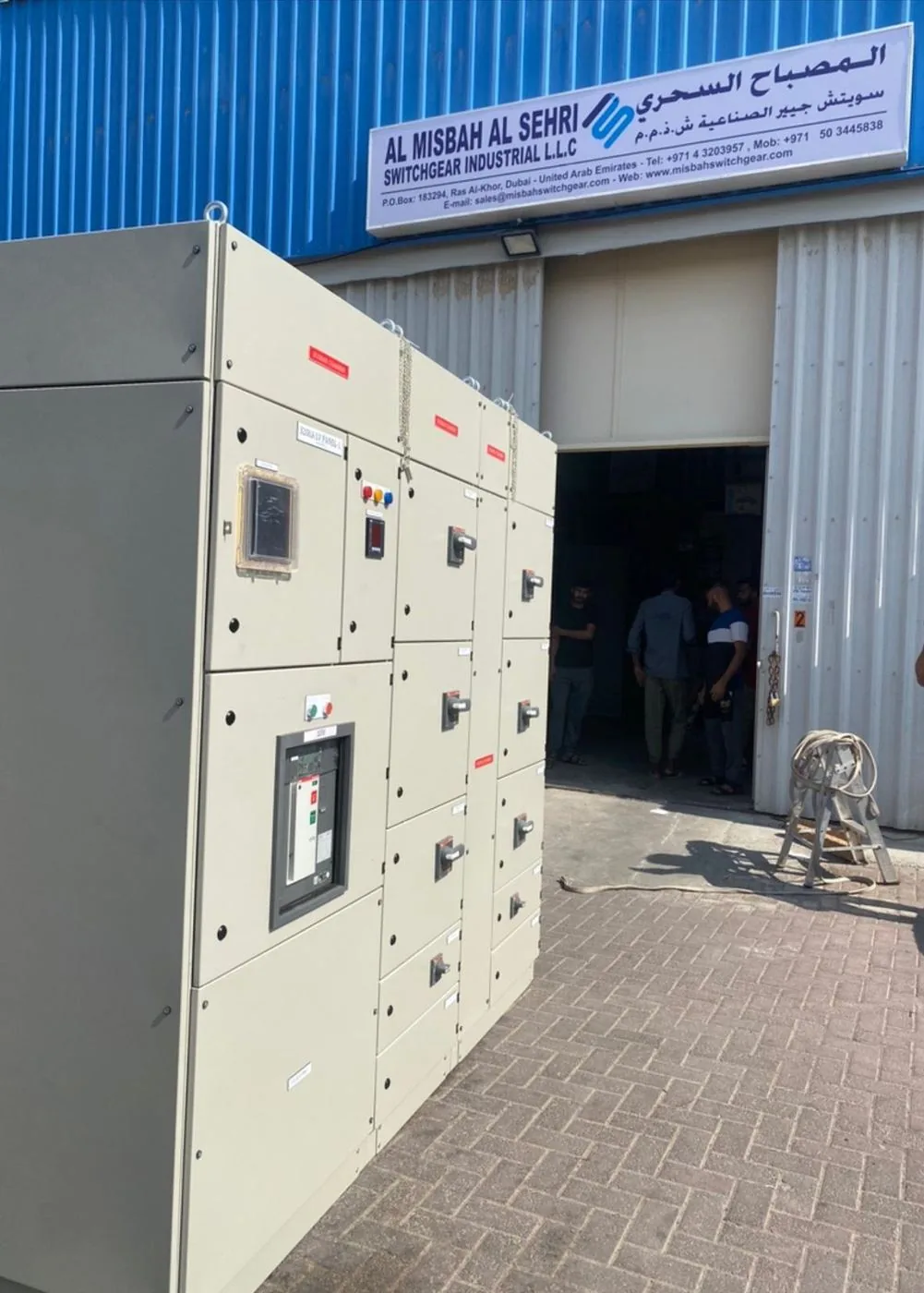
Match the breaker to the load and fault level. For a large MDB above about 1600 A, near a big transformer, or where a withdrawable, fully maintainable main incomer is specified, an ACB is the right call. For smaller MDBs and SMDBs — broadly up to 1600 A with moderate fault levels — an MCCB incomer is compact, cost-effective and perfectly compliant. Always confirm the rating against your prospective short-circuit current and required protection coordination. Al Misbah Al Sehri manufactures MDB, SMDB and MCC panels in Dubai to IEC and DEWA-standard practice, and we supply genuine ACBs and MCCBs from ABB, Schneider, Legrand, Himel, Eaton and other brands — so you can specify either option with confidence. Send us your single-line diagram for a quote.